TL;DR
The essential motorcycle travel books are Jupiter’s Travels by Ted Simon, Lone Rider by Elspeth Beard, Ghost Rider by Neil Peart, Long Way Round by Ewan McGregor and Charley Boorman, and Investment Biker by Jim Rogers. Read Ted Simon first. Once you have been through the famous ones, the genre opens up considerably, and that is where smaller authors, including me, come in. I have listed my own eight at the end, clearly separated, so you can discount them as you see fit.
Someone asks for a motorcycle travel book recommendation most weeks, usually in a forum or a comment under something I have written. The same four or five titles come back every time, and they come back for good reason.
I write in this genre, which makes me useful and biased in roughly equal measure. So here is the deal for this article: the well-known books first, recommended properly, because they deserve it. My own at the end in a section you can skip.
The ones everybody names, and why
Jupiter’s Travels by Ted Simon
Four years riding around the world in the seventies, across 45 countries, on a Triumph Tiger.
This is the book that made the genre what it is. It came before adventure motorcycling was a category with its own bikes and its own magazines, so it is not really about equipment or preparation at all. It is about what happens to somebody over four years of being a stranger everywhere.
Read it first. Nearly everything since has been written in its shadow, including mine.
Lone Rider by Elspeth Beard
Beard rode around the world in the early eighties, alone, in her twenties, at a time when a woman doing so attracted a level of comment that is difficult to imagine now.
The riding is remarkable and so is the account of everything around it. Notably, she wrote the book decades after the journey, which gives it a perspective most of these books do not have.
Read it if you want the hardest version of the round-the-world ride.
Ghost Rider by Neil Peart
Peart, the drummer with Rush, rode roughly 55,000 miles after losing his daughter and his wife within a year of each other, from Quebec up to Alaska and south as far as Belize.
It is a motorcycle book in the sense that the motorcycle is what he did with the grief. Be aware of what you are picking up: it is a book about bereavement with a BMW in it.
Read it if you want the one that is least like the others.
Long Way Round by Ewan McGregor and Charley Boorman
London to New York the long way, and the book that came with the television series.
More riders came into this genre through Long Way Round than through anything else, which is worth respecting even if you find the production side of it a distraction. The support vehicles and the film crew make it a different sort of expedition to the others here.
Read it if you want the accessible one, or if the series was your way in.
Investment Biker by Jim Rogers
An investor and his girlfriend ride round the world on a pair of BMWs in the early nineties, through fifty-two countries, and he looks at each country’s economy as he goes. The trip went into the Guinness Book of Records.
An odd inclusion in a list like this, and that is the point. It is as much about how countries work as about riding through them, and it holds up as a snapshot of a world in the middle of changing.
Read it if you want something that is doing a second job alongside the travel.
What these five have in common
Each was written by the person who made the journey. Each contains the sort of specific detail nobody would invent: the wrong noise, the tedious border, the small kindness from a stranger who had no reason to bother. And each is honest about the parts that went badly.
Those are the three things I would look for in any book in this genre, famous or otherwise.
Where the genre goes after the famous five
Most people arrive at this point having read three or four of the above, wanting something that is not on every list.
The useful move is to stop searching by destination and start searching by machine. Adventure motorcycling writing is dominated by riders on purpose-built adventure bikes, doing it properly. That produces a certain sort of book: competent, well-organised, and a bit predictable, because the machine was designed to cope and largely does.
Books written by people on obviously unsuitable bikes are a different read. The difficulty stops being arranged and becomes real, and the author has to be honest about it because the alternative is pretending a chopper is good in sand.
That is the corner of the genre I have spent my life in, mostly through poor judgement.
My own eight, since you are here
Now the biased section, clearly labelled. Skip it if you would rather.
I have written eight books in this genre. The common thread is that I keep taking the wrong motorcycle to places it has no business being, and the joke is usually at my expense.
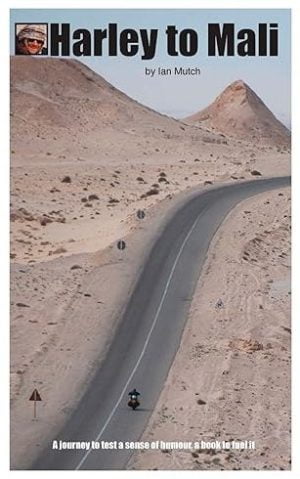
Harley to Mali — £6.99 paperback, also on Kindle
Crossing the Sahara to Mali on a Harley-Davidson Dynaglide Custom, alongside serious overlanders on BMW GS machines. Minefields in Mauritania, 100km off-road stretches, and a bike with modest ground clearance, the weight of a dumper truck and enough chrome to frighten the camels.
Read it if: you want to know quickly whether my sort of book is for you. This is the one to start with.

Low Rider — £6.99 paperback, also on Kindle
A month of mechanical mayhem on a rigid-frame 1970s Triumph chopper, through the freezing mountains of the old Yugoslavia, down to the Red Sea and the Dead Sea in Israel, and back to the Mediterranean, part way across virgin desert when the road unexpectedly ends. The bike Ewan McGregor and Charlie Boorman sensibly did not choose. Illustrated by Louise Limb.
Read it if: you enjoy watching a plan meet a bike that was never built for it.
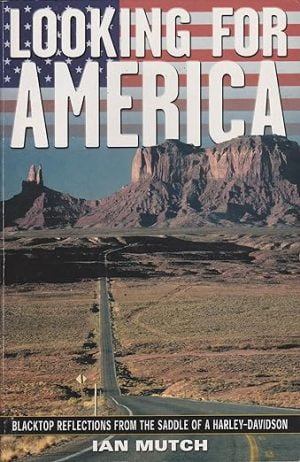
Looking For America — £6.99 paperback, also on Kindle
In 1969 a spotty seventeen-year-old watched two Harley-Davidson choppers roll across America in a new film called Easy Rider, and promised himself he would do that one day. Twenty years later he did, on a 1340cc Harley-Davidson FXR, from the Mid West to the Pacific and on to New York.
Read it if: Easy Rider was part of how you came to motorcycling.

Riding With The Beast — £6.99 paperback, also on Kindle
What would you do if, several months into a relationship, you discovered your girlfriend had turned into a grizzly bear? In the freezing winter of 1991 I set off for Wales on a BMW R100RS with a bear cub on the pillion seat, bound for an ice-bound caravan in the Wye Valley. It was the year the Wye froze. Then a run to Glastonbury, and a two-month voyage to Israel via France, Italy and Greece on a Harley-Davidson, falling in with prophets and pilgrims on a campsite overlooking the old city of Jerusalem.
Read it if: you want the strangest of the eight.
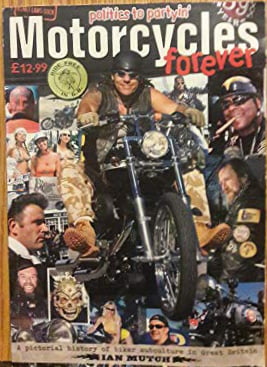
Motorcycles Forever — £12.99 paperback, this site only
The only picture book of the eight: a picture book with a lot of text behind the pictures, looking at the biker scene from the seventies through to the end of the century, and at what MAG did to keep the government’s hands off it. There are sections on the Harley-Davidson Riders Club of GB, on Rockers, on HOG and others, and it charts the legal battles fought to defend a way of life that from the outside probably looked a little edgy and dangerous. Riding with the wind in our hair indeed.
Not on Amazon and there is no Kindle edition, so this site is the only place to buy it.
Read it if: you care about how British motorcycling got to where it is.
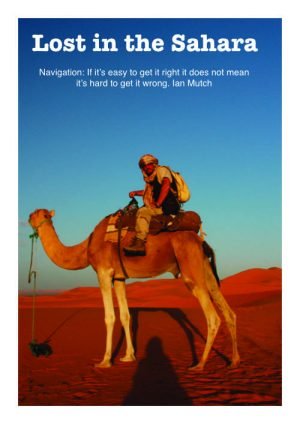
Lost in the Sahara — Kindle only
When no traffic comes the other way for an hour on a desert road, it is time to worry. When blown sand has hidden the road behind you, worry a little more. When the last of the water is gone and the road ends in a heap of rubble, it is time to cry, and to hope a Berber tribesman appears with a camel called Jimi Hendrix.
Read it if: you want to try my writing before committing to a paperback.
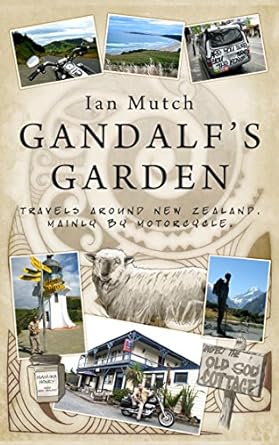
Gandalf’s Garden — Kindle only
Three months of hopeless quests around New Zealand on a Harley-Davidson, setting out with a negative bank balance and an impossible tax demand, and experimenting with self-denial that begins with dinner at Raffles Hotel during a Singapore stopover.
Read it if: you have ever set off on a trip you could not really afford.

Turkish Delight — Kindle only
A journey to Istanbul on a Harley-Davidson. A story of ineffable self-deprecation, in the words of one reader, for those of us who are not A-Team alpha.
Read it if: you would rather laugh at the rider than admire him.
If you would like more on how the genre works and which of these to read first, I have written a fuller guide to motorcycle travel books and where to start. If you are buying for somebody else, there is a separate piece on gifts for motorcyclists.
Frequently asked questions
What is the best motorcycle travel book of all time?
Jupiter’s Travels by Ted Simon is the usual answer and it is the right one. Simon spent four years riding around the world in the seventies, across 45 countries, before adventure motorcycling existed as a category with its own machines and magazines. That timing matters: the book is not about kit or preparation, because neither was available to him in any organised form. It is about what four years of being a stranger does to a person. Almost everything written in the genre since has been written in its shadow. If you read only one motorcycle travel book, read that one.
What should I read after Jupiter’s Travels?
Lone Rider by Elspeth Beard is the strongest next step, an account of riding around the world alone in the early eighties, written decades afterwards with the perspective that gives. Ghost Rider by Neil Peart is worth knowing about but is really a book about bereavement with a motorcycle in it, so pick it up deliberately rather than by accident. After the famous handful, the useful trick is to stop searching by destination and start searching by machine: books written by riders on unsuitable bikes read differently from books by riders on purpose-built adventure machines, because the difficulty is real rather than arranged.
Are there any funny motorcycle travel books?
Yes, though the genre leans earnest. Adventure writing has a pull towards competence, because the author knows how the story ends and it is tempting to narrate the whole thing as though it were under control. The funny ones are usually written by riders who were underprepared, on the wrong machine, or both, and who are willing to say so. My own eight titles sit in that group, mostly because I have a long record of taking a Harley-Davidson somewhere a Harley-Davidson should not go. If you want to test whether that appeals before spending much, Lost in the Sahara is Kindle only and short.
Who writes motorcycle travel books in the UK?
The UK has a strong tradition in the genre. Ted Simon and Elspeth Beard are the best-known names internationally. I am a UK author of eight titles in this field, based in Glastonbury, Somerset, and I founded the Motorcycle Action Group in 1973 and edited its magazine, The Road, for twenty-eight years. My books are written from direct personal experience, generally on machines poorly suited to the journey in question.
Is it worth reading motorcycle travel books if I do not ride?
Usually yes. They are travel books in which the motorcycle is the means of getting there and the source of most of the trouble, so the appeal does not depend on technical knowledge. A reader does not need to know what a rigid frame is to follow somebody nursing a 1970s Triumph through Yugoslavia in winter. The exception is books mainly concerned with the riding itself rather than the places, which are more of an insider read.